Welcome to the Peers in Practice inhale hub. Here you will find information to support your COPD consultations with your patients
Adverse events reporting and prescribing information can be found at the bottom of the page.
This material was developed in collaboration with a UCL Business company, Personia Health, industry leaders in the application of validated behavioural science frameworks and tools developed from extensive research into helping patients and healthcare professionals to get the best from treatments by enhancing engagement, adherence and persistence to optimise health.1
Healthcare professionals have been consulted by GSK and received honorarium.

Practical Tips for the Patient Discussion
COPD inhaler adherence starts with the right conversation.
When patient consultations address necessity, concerns and practical barriers, clinicians can move beyond device preference and support patients with achievable, confidence-building steps.
Read on to explore practical ways to support behaviour change and improve inhaler adherence in COPD.
Read on to find out more
Bridge the gap between patient concerns and change

Patients don't always explain their concerns directly.
Explore what may be driving hesitation, and how to address it in a supportive, patient-centred way.
“I'm worried I won't be able to get through the night with just one dose a day”

Open the conversation
Why are you unsure about getting through the night with one dose?
Acknowledge the concern
Provide information
Some inhalers are designed to work for 24 hours, including at night.2
Studies show that once-daily inhalers can be just as effective as inhalers used twice a day.3
Using your inhaler at the same time every day helps keep symptoms under control.2
“I don’t see why I need to take my inhaler every day”

Open the conversation
What do you think the inhaler is mainly helping with?
Acknowledge the concern
Provide information
Using your inhaler every day helps manage COPD by addressing the underlying airway inflammation that may be present.4
Using your inhaler at the same time each day helps it work effectively to maintain 24‑hour symptom control.2
Regular use can also support your physical and mental wellbeing by helping you stay active.5
“There’s nothing that can be done for my COPD. I don’t see a need to try another inhaler”

Open the conversation
What experiences have led you to feel that way?
Acknowledge the concern
Provide information
Treatments for COPD are backed by strong evidence and there are several effective ways to manage COPD.6
There are also other opportunities to improve outcomes, such as pulmonary rehabilitation and stopping smoking.6
“I can’t breathe in enough to use my inhaler”

Open the conversation
Would it help to look at how the inhaler works together?
Acknowledge the concern
Provide information
Resources are available to help you use the Trelegy Ellipta (fluticasone furoate/umeclidinium/vilanterol) device correctly, including training devices to check your inspiratory flow.
“Sometimes I get a dry powder feeling at the back of my throat and other times I don't. So, I don't feel confident in getting a dose or a full dose is being delivered”

Open the conversation
Would it help if we went through how to tell when your inhaler is working properly?
Acknowledge the concern
Provide information
Sometimes you may taste/feel the powder or experience a dry mouth when using your Trelegy Ellipta, while at other times you won't. But the medicine should still reach your airways as long as you're using the inhaler correctly.4
Not real patients. Images and quotes are for illustrative purposes only.
Practical ways to support small, achievable changes
Small, achievable goals can help patients build confidence and make change feel manageable.
The approaches below offer simple ways to support patients as they begin to set new goals and fit changes into their everyday routines.
Please note that the Trelegy Ellipta COPD Patient Support Packs are only available for patients once a Trelegy Ellipta® prescribing decision has been made.
Start Small
Encouraging patients to start with small, achievable goals can help build confidence early.
For example, starting with short, daily breathing exercises.
Stack Habits
Linking new habits to existing routines can make change feel easier to sustain.
For example, taking their inhaler when making the bed, reading the newspaper in the morning, filling in their daily symptom tracker. See more examples in the Trelegy Ellipta COPD Patient Support Pack.
Make It Social
Involving family and friends for support.
Could they bring a loved one to their COPD appointments to help them remember important information and provide emotional support?
Make It Fun
Adding enjoyment to everyday tasks may help patients stay engaged with new routines.
For example, listening to their favourite music or the radio to make the process more engaging. See more examples in the Trelegy Ellipta COPD Patient Support Pack.

Celebrate
Recognising progress, even small successes, can help reinforce positive change.
For example, highlighting your patient’s achievements, such as maintaining a medication schedule or improving exercise tolerance.
“Patients with COPD need confidence that their inhaled medication reaches their lungs — and that confidence starts with the clinician. Resources such as the Inhale Hub can help clinicians build this confidence and support patients in using their inhaler correctly.”
 Who is Beverley Bostock?

Listening to understand the patient perspective
Open questions can help uncover what matters to patients, what concerns them, and what may be getting in the way of change.
These examples are intended as conversation starters — not a script — and can be adapted to suit your own consultation style.
On a scale of zero to ten, how worried are you about changing to a different inhaler? Where zero is not worried at all and ten is extremely worried. What would it take for you to go down to a lower number?
How would you like things to be different?
How has your COPD stopped you from doing your daily activities and what you want to do in your day-to-day life?
What could support you in making these changes?

Practical support beyond the consultation
Grounded in behavioural science, the Trelegy Ellipta COPD Patient Support Packs include a range of simple, easy-to-use materials designed to help patients fit inhaler use into everyday life, understand their treatment, and work towards realistic goals over time.
Trelegy Ellipta COPD Patient Support Packs are available for patients once a Trelegy Ellipta® prescribing decision has been made.
Explore the Resources Page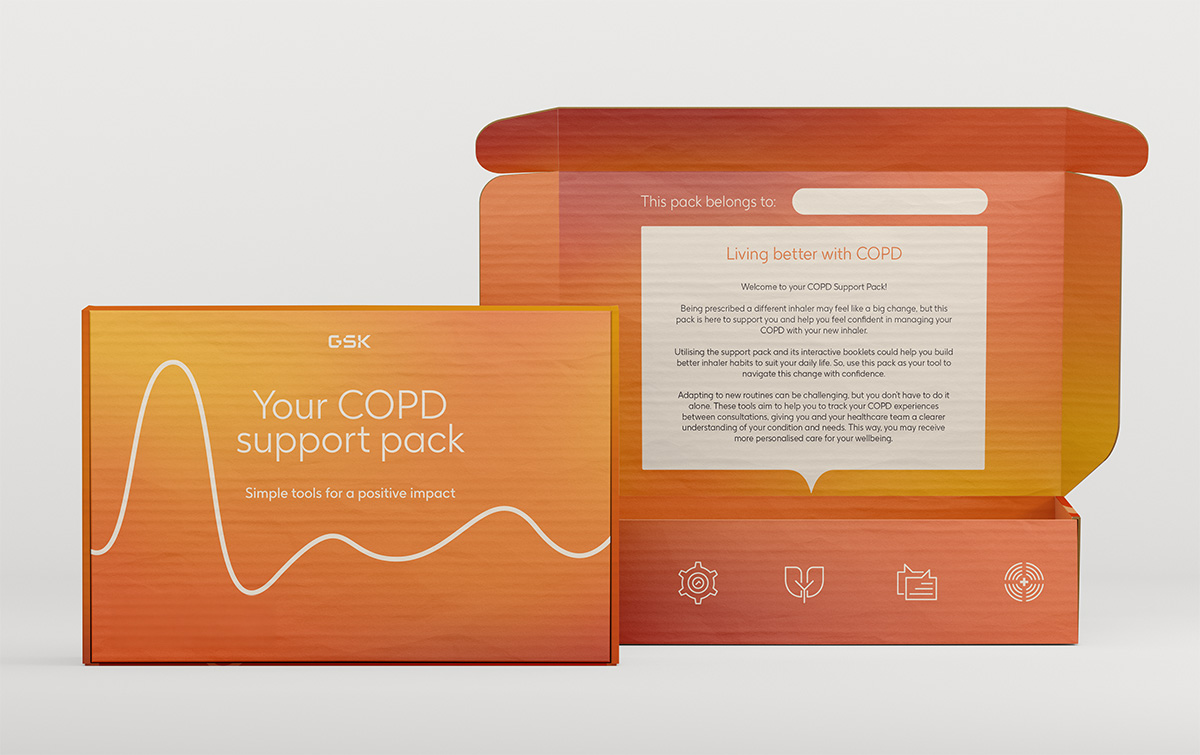

Case Study:
COPD Management in Practice
See how Beverley Bostock approaches COPD care to support improved patient outcomes.
 Who is Beverley Bostock?
Abbreviations
ARNS, Association of Respiratory Nurse Specialists; COPD, chronic obstructive pulmonary disease; NICE, National Institute for Health and Care Excellence; PCRS, Primary Care Respiratory Society.
References
- Personia Health, a University College London Business company - making the most of medicines and vaccines. Available at: https://personiahealth.com
- Trelegy PIL. Available at: https://www.medicines.org.uk/emc/files/pil.8666.pdf
- Rogliani P, et al. J Clin Med. 2022;11(15):4491.
- Trelegy Summary of Product Characteristics. Available at: https://www.medicines.org.uk/emc/product/8666/smpc
- Jardim JR and Nascimento OA. Med Sci (Basel). 2019;7(4):54.
- GOLD. Global strategy for the Diagnosis, Management and Prevention of COPD. 2026 Report. Available at: https://goldcopd.org/2026-gold-report-and-pocket-guide/
March 2026 | PM-GB-CPU-WCNT-240013 (V2.0)
For the Trelegy Ellipta® (fluticasone furoate/umeclidinium/vilanterol) prescribing information Click here.
Beverley is an Advanced Nurse Practitioner in Gloucestershire and an independent prescriber. She is the Asthma Lead for ARNS, Chair of the ARNS Respiratory Diseases committee, and sits on the Executive Committee of the PCRS and Asthma and Lung UK's Council of Healthcare Professionals. She holds an MSc in Respiratory Care and an MA in Medical Ethics and Law. Bev was part of the NICE Asthma Quality Standards development and the National Review of Asthma Deaths. She is Editor in Chief of Practice Nurse Journal and has been a Queen’s Nurse since 2015.